Ever been stuck in a sweaty, clingy top halfway through a vinyasa flow? Or had your waistband roll down right in the middle of a deep squat?
When your clothing fights your movement, your practice suffers. The right yoga wear should disappear on your body—so you can focus entirely on your breath, alignment, and flow.
But here’s the thing: price tags and brand names don’t guarantee performance. The secret to a great yoga outfit is hiding in plain sight—right there on the fabric care label.
This guide breaks down exactly what to look for. By the end, you’ll be able to read any fabric composition tag like a pro and pick the right gear every single time.
The 3 Essential Fibers You Need to Know
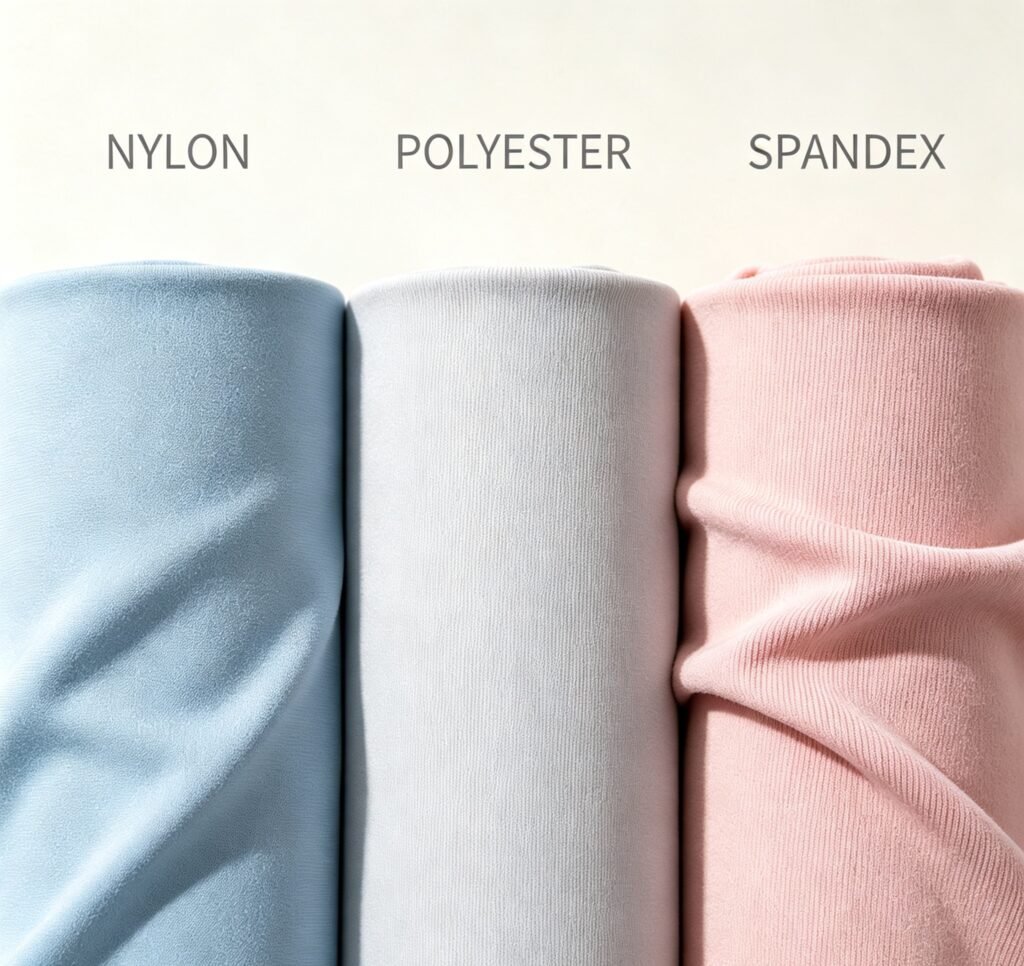
Every high-quality yoga garment is made from a blend of three core fibers. Understanding each one is your first step to smarter shopping.
1. Nylon (Polyamide) – The “Second Skin” Fiber
Nylon is the gold standard for premium yoga wear. It’s prized for its incredible softness, lightweight feel, and excellent recovery (meaning it bounces back to shape after stretching).
Think of nylon as the ingredient that determines the comfort ceiling of your outfit. It feels smooth against your skin—never plasticky or scratchy. Unlike some cheaper synthetic fabrics, nylon also has better inherent moisture absorption, which helps reduce that clammy feeling during hot yoga or sweaty sessions.
What to remember: When you see “buttery soft” or “barely there” in product descriptions, that’s nylon at work.
2. Polyester – The Quick-Dry Champion
Polyester is the workhorse of performance fabrics. It’s tough, wrinkle-resistant, and wicks moisture away from your skin at lightning speed.
Here’s how it works: polyester pulls sweat from your skin to the outer surface of the fabric, where it spreads out and evaporates quickly. This makes it a great choice for high-intensity activities like running or HIIT.
But a word of caution: Low-grade polyester can feel clammy or static-y because it doesn’t absorb moisture as well as nylon. If your main activity is yoga (not sprints), prioritize nylon over polyester for next-to-skin comfort.
3. Spandex (Lycra® / Elastane) – The Stretch Engine
Spandex is the spring in your step. It can stretch up to 5-7 times its original length and snap back to shape without losing tension.
The brand-name version, Lycra®, is generally superior to generic spandex—it offers better shape retention and holds up longer after repeated washing.
But here’s the catch: more spandex doesn’t always mean better stretch. Too much can make the fabric feel heavy and “over-squeezed,” while too little leaves you feeling restricted.
The Magic Ratio: How Much Spandex Is Just Right?
This is the single most important number to check on any care label.
| Activity Level | Ideal Spandex Content | Best Paired With |
|---|---|---|
| Yoga / Pilates (low-medium intensity) | 12% – 18% | Nylon for softness & recovery |
| Running / HIIT (high intensity) | 8% – 12% | Higher-tenacity nylon for durability |
Pro tip: The sweet spot for premium yoga leggings and tops is 75% Nylon + 25% Spandex. This combo delivers the perfect balance of cloud-like comfort, four-way stretch, and lasting shape retention.
If you see a blend of 80% Nylon + 20% Spandex, that’s also a solid, slightly more budget-friendly option.
Remember this rule: The higher the nylon percentage, the softer the feel. The spandex percentage (12–18%) tells you how much freedom you’ll have to move.
2 Red Flags to Watch Out For
❌ Skip 100% Cotton
Cotton feels great in a t-shirt, but it’s a disaster for yoga. It acts like a sponge—absorbing sweat and holding it against your skin. The result? Heavy, saggy fabric that chafes, clings, and leaves you feeling cold and damp halfway through your practice.
Save cotton for your lounge days, not your flow days.
⚠️ Be Cautious with “Water-Resistant” or “Stain-Repellent” Finishes
If you see a yoga top or legging marketed as “water-repellent” or “anti-stain,” and it doesn’t explicitly say “PFC-free,” it’s likely treated with PFAS chemicals (per- and polyfluoroalkyl substances).
Here’s the thing: yoga is an indoor activity. You don’t need water resistance. You need breathability, sweat-wicking, and skin comfort. Avoid unnecessary chemical coatings—they reduce breathability and serve no real benefit for your practice.
2 Quick At-Home Tests Before You Buy
1. The Squat Test
Try the leggings on and do a deep squat right in the fitting room. Listen closely.
- Any loud “swish-swish” friction sound? That’s a sign of low-quality fabric that’s likely to pill or lose tension after a few washes.
- Silent and smooth? That’s a good sign—the knit is dense and the tension is well-balanced.
2. The Stretch & Light Test
Gently stretch the fabric and hold it up to the light.
- Even, fine pores with consistent light distribution? Great—the weave is tight enough to prevent see-through.
- Uneven gaps or thin spots? Skip it—this fabric will likely become sheer during bending.
Final Checklist: Your 3-Second Label Scan
Next time you’re shopping for yoga wear, ignore the marketing fluff and flip to the care tag. Ask yourself:
- Is nylon the primary fiber (not polyester)? → Yes? Good. You’re on track for softness.
- Is spandex between 12% and 18%? → Yes? Great. You’ve got the ideal stretch range.
- No “water-repellent” coating listed? → Perfect. Breathability is preserved.
Get these three right, and you’ll never have to think about “will my leggings survive this class?” again.
Now go ahead—breathe deep, move freely, and let your yoga wear do exactly what it’s supposed to do: support you, not distract you.
Care Tip (Bonus)
To make your yoga wear last longer, always wash in cold water on a gentle cycle with mild detergent. Avoid fabric softeners—they coat the fibers and ruin moisture-wicking performance. Hang to dry in the shade; never leave them under direct sunlight for extended periods, as UV rays can degrade nylon’s elasticity over time.
Loved this guide? Share it with a fellow yogi who’s tired of guessing which leggings to buy. And if you have questions about a specific fabric blend, drop a comment below—I’ll help you decode it. 🧘♀️